
 Selling
04 Feb 2026
Why 2026 Could Be a Smart Time to Sell Your Home in Stanmore, HA7
After a cautious couple of years in the property market…


Selling
What Made Buyers Choose Them?
As we enter November, the Chelmsford (and British) property market is full of mixed messages. If you are thinking of moving home in early 2027, understanding what is selling in Chelmsford, and why, could make a considerable difference to your next move.
If you have been following the property headlines, you could be forgiven for wondering whether now is a sensible time to sell your Chelmsford home?
The Bank of England is due to announce on Thursday 5th November what the base rate will be, and most commentors believe they will be raised to 4% (from the current 3.75%). This is because there is an inflation spike due to higher energy and transport fuel costs. Yet the other side of the coin is the fact that the UK economy as a whole has seen relatively robust economic GDP figures (ranking among the fastest growing in the G7) for the first half of 2026, meaning the Bank has a small economic cushion to raise rates, without fearing an immediate recession.
But these national headlines cannot tell you what a buyer will pay for your Chelmsford home, how much competition you will face or what your next home might cost. So as we enter November, I want to look at the market through a more useful lens.
How many Chelmsford homes are finding buyers? Which price ranges are attracting those buyers? And what does that mean if you want to move in early 2027? Because there are buyers out there. The challenge is understanding how to make your Chelmsford home the one they choose.
Starting with the national picture across the UK, 761,480 net sales were recorded up to the third week of October (net sales being gross sales agreed less those sales that fell through). That is 6.4% below the 813,840 recorded over the same period in 2025 and 2.6% below the 781,849 in 2024, confirming that this has been a tougher year for getting homes sold.
Yet some perspective matters. Net sales in 2026 remain 14% above the 668,114 recorded in YTD 2023 and 2.7% ahead of the equivalent average for the pre-Covid years of 2017 to 2019. Of course the property market has lost some momentum compared with 2024 and 2025, but buyers are still moving in substantial numbers. For homeowners, that means a sale is achievable, although realistic pricing and standing out against competing properties matter.
Now, let us look at October in isolation where I want to compare the price ranges of homes on the UK property market with those going sold subject to contract. The proportion of homes finding a buyer in October varied considerably by price bracket.
Below £250,000, 16.2% of homes agreed a sale during the month, roughly one in six. That fell to 12.3% between £350,000 and £500,000 (1 in 8), 8.7% between £750,000 and £1 million (1 in 11), and 7.3% between £1 million and £2 million (1 in 14) and 1 in 53 for anything over £5m.
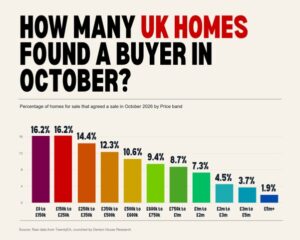
Why is this important? By understanding how many properties are competing against yours is so important. Nationally, for every home that sold stc, eight didn’t.
These figures do not mean that the remaining homes will never sell, simply that they did not secure a buyer in October. For UK homeowners planning a move in early 2027, the message is again very clear: understand the competition within your own price bracket and set an asking price that gives buyers a compelling reason to choose your home.
Looking at Chelmsford in the postcode districts of CM1, CM2 and CM3, these are the numbers of sales agreed between 1st January to the 24th October in each year:
As you can see, Chelmsford homes sales are below 2025 but above 2023. That describes a market in which activity has eased over the last year, while remaining ahead of the more subdued conditions of 2023.
Just as an added aid, let me look at the Chelmsford home sales in price bands on the sales agreed in the last month …
Across these brackets, there were 307 sales agreed against 2,326 homes for sale, equivalent to approximately one sale for every eight available properties.
Remember though, this is a comparison of monthly activity with stock, rather than a prediction of whether your own home will sell.
Buyers assess your property alongside the alternatives their budget allows. They compare location, usable space, condition, parking and the work they might need to undertake. The asking price needs to reflect that complete picture.
A nearby home on the market at £450,000 tells us what its owner hopes to achieve. If it has remained available for months, we should ask whether buyers see enough value at that figure.
A city-wide average can only take us so far. When advising you, I want to examine comparable homes that have found buyers, understand why others remain unsold and identify where your property fits. That provides a stronger foundation for negotiation than simply choosing the most appealing valuation.
I understand why homeowners want to leave room for negotiation. Your sale proceeds may determine whether you can afford your next home, and even a relatively small difference can matter enormously. My responsibility is to help you achieve the best price the market will support. That means recommending a starting price we can defend with evidence, then marketing your home in a way that makes its advantages clear. As I highlighted recently in a blog post …
Only 51.55% of all Chelmsford homes that left Chelmsford estate agents books in the last 2 years sold and completed (the remaining withdrew unsold) … and of those that did sell and complete, 80.3% of them had no recorded asking price reduction.
The aim should be to begin with a credible price and assess the response honestly. If enquiries or viewings disappoint, we need to investigate presentation, exposure, access and price promptly.
Most sellers will also be buyers, so the gap between the two properties deserves careful attention. Suppose you hoped to achieve £300,000 and intended to buy at £450,000. The gap is £150,000, before moving costs. If you agreed £290,000 for your sale but negotiated your purchase to £430,000, that gap would fall to £140,000.
This is just an illustration, rather than prediction. Different properties will perform differently, and another Chelmsford seller may have little room to negotiate. However, it shows why accepting less than you initially hoped for can sometimes still improve the financial outcome of your complete move.
My advice is to build your plans around today’s evidence. Forecasts may suggest a direction for national prices, but they cannot determine what a particular Chelmsford buyer will pay for your home. Even if prices rise next year, the property you want to buy could become more expensive too.
If moving in 2027 is your intention, now is a sensible time to understand your likely selling range, assess the competition and consider any preparation that would improve your position. A successful move starts with clear expectations and a price buyers can justify.
If you would like a frank, no obligation conversation about what that means for your Chelmsford home, give me a call.
Lets get started! Our valuations are based on our extensive knowledge of the whole of the market.
Get a valuation Selling